How do porta potties work?
A porta potty is a sealed holding tank of about 60 to 70 gallons under a seat, charged with a few gallons of water and a blue deodorizer that masks odor and slows bacteria. A vent pipe carries gases out above the roof. About once a week a service truck vacuums the tank out, the unit is cleaned and recharged, and the waste goes to a treatment plant.
From manufacturer safety data sheets and manuals, state codes, OSHA letters and wastewater utility rules, read November 2026.
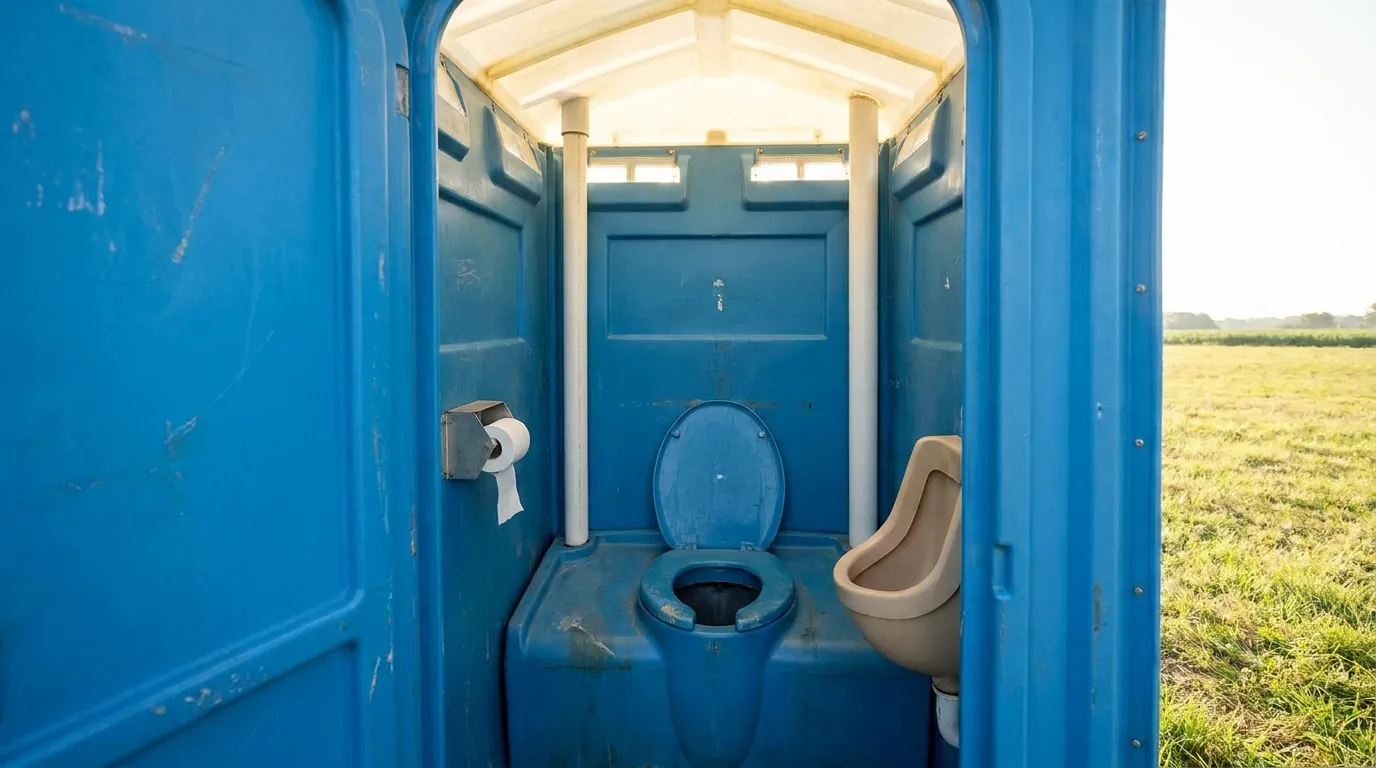
What is inside a porta potty
Holding tank
The tank under the seat holds 60 gallons in a PolyJohn PJN3 and 70 gallons in a Satellite Tufway. Standard units often have a 60 to 65 gallon tank. SatelliteWater and deodorizer
Before use, the tank is charged with about 5 gallons of fresh water mixed with deodorizer, the blue liquid. PolyJohn instructionsUrinal
Standard units have one, draining into the same tank. Maricopa County, Arizona requires every chemical toilet to include a urinal.Vent pipe
A pipe from the tank up through the roof carries gases out. Oregon requires a vent stack at least 4 inches wide rising 12 inches above the roof. OAR 340-073-0065Self-closing door and latch
Florida, Arizona and Oregon all require self-closing doors, and Arizona and Oregon an inside latch. Arizona R9-8-303
How a service visit works
- Empty the holding tank completely through a vacuum hose into a leak-proof tank on the truck.
- Clean and sanitize all inside surfaces, and clean the outside.
- Recharge the tank with fresh water and odor-control solution.
- Refill the toilet paper, and the hand sanitizer where there is a dispenser.
Steps from a DeKalb County, Georgia portable toilet contract.
How often
OSHA cites the ANSI Z4.3 schedule: a toilet used by up to 10 people serviced at least once a week (OSHA letter, 2006). Florida requires weekly service and daily service at special events, and Philadelphia every 48 hours in residential areas. Satellite Industries puts a standard unit at about 250 uses before service. Extra visits are billed separately: $10 to $65 on public bids and contracts.
What the blue liquid is made of
Ingredients as listed on manufacturers’ safety data sheets and product pages. The blue is dye: it hides the tank contents.
| Product | Type | Dose |
|---|---|---|
| PolyJohn King Blue liquid | Non-formaldehyde | 1 to 3 oz per 5 gallons of water |
| Satellite STF 5K liquid | Non-formaldehyde | 2 oz per 5 gallons |
| Stearns Porta-Fresh packets | Quaternary ammonium (quats) | 1 packet per 40 gallon tank |
| Walex Porta-Pak (RV holding tanks) | Bronopol biocide | Per pack |
| Alken Treat-A-Loo | Bacteria and enzymes | 1.5 oz per 5 gallons of water |
A portable toilet chemical maker sums up the mix as “biocides, dye, fragrance and detergents” (Surco). The biocide slows the bacteria that make the smell; the detergent and fragrance do the rest.
Formaldehyde and other biocides
Mostly gone from current products
PolyJohn, Satellite, Zep and Surco describe their deodorizers as non-formaldehyde. Satellite says its STF, introduced in 1975, was the first. SatelliteSome plants refuse it
Virginia’s Upper Occoquan Service Authority accepts portable toilet waste but rejects loads containing formaldehyde or 1,4-dichlorobenzene, and asks haulers for the deodorizer’s safety data sheet. UOSAQuats limits
Florida bars companies using quaternary ammonium deodorizers from taking that waste to lime stabilization facilities. Fla. Admin. Code 62-6.0101California
Since 2022, California bans selling holding tank products with formaldehyde, glutaraldehyde, bronopol and similar chemicals for RVs and for campground chemical toilets that drain to septic systems. SB 317Biological options
Some treatments use bacteria and enzymes instead of a biocide, and Satellite markets a biocide-free winter packet that dissolves in brine.
Where the waste goes
Counted as septage
Federal rules define domestic septage to include material removed from a portable toilet. 40 CFR 503.9Treatment plants take it
Austin’s Walnut Creek receiving station accepts septic tank and portable toilet waste, and Iowa requires portable toilet wastewater to go to a public sewage treatment facility. City of AustinNot every plant
Oakland County, Michigan’s septage site does not accept portable toilets, and Chicago’s water reclamation district takes chemical toilet waste only under permit, at its Stickney plant. MWRDFor a fee
Plants charge haulers by the gallon, from about 5 to 27 cents. Rates are on the business costs page.
In winter
Frozen water can split a tank, so operators add salt brine. Satellite’s cold weather guide puts half a pound of salt per gallon at protection to 26°F and 2 pounds per gallon to 0°F, and the salt has to be mixed into water first or it settles while the top freezes. Below that, Satellite describes a 30% methanol mix with 2 pounds of salt per gallon down to −40°F; PolyJohn warns that methanol over 33% makes tanks flammable. Satellite also notes that winter often means more frequent servicing.
In summer
Heat and heavy use bring out the smell. Deodorizer makers sell stronger formulas for high temperatures and above-average use, and the fix on site is more service visits. For an event, size the order with the calculator and ask for service during the event if it runs long.
The unit types, from standard to restroom trailers, are compared on the types page.
Common questions
How does a porta potty work?
Waste drops into a sealed holding tank of about 60 to 70 gallons under the seat. Before use the tank is charged with roughly 5 gallons of water mixed with a deodorizer, the blue liquid, which masks odor and slows bacteria. A vent pipe carries gases out above the roof. A service truck vacuums the tank out, the unit is cleaned and restocked, and the tank is recharged.
What is the blue liquid in porta potties?
A deodorizer mixed with water in the holding tank. Safety data sheets for current products list surfactants (detergents), fragrance, blue dye and water, and many add a biocide such as quaternary ammonium compounds or bronopol to slow the bacteria that cause odor. One portable toilet chemical maker sums it up as biocides, dye, fragrance and detergents.
Is the blue liquid formaldehyde?
Not in most current products. PolyJohn, Satellite, Zep and Surco all describe their portable toilet deodorizers as non-formaldehyde, and Satellite says it introduced the first non-formaldehyde portable restroom deodorizer in 1975. Some treatment plants refuse loads that contain formaldehyde, and Zep sells its product for places where formaldehyde is restricted.
How do you empty a porta potty?
A service technician pumps the tank out with a vacuum hose into a sealed tank on the service truck, then cleans and sanitizes the inside, adds fresh water and deodorizer, and restocks toilet paper. The truck takes the waste to a wastewater treatment plant or septage receiving station.
How often does a porta potty need to be emptied?
Usually once a week. OSHA cites the ANSI Z4.3 servicing schedule, which calls for a toilet used by up to 10 people to be serviced at least once a week. Florida requires weekly service and daily service at special events, and Philadelphia requires service at least every 48 hours in residential areas. Satellite Industries puts a standard unit at about 250 uses before service.
Where does porta potty waste go?
To a wastewater treatment plant. Federal rules count material removed from a portable toilet as domestic septage, and plants such as Austin's Walnut Creek station accept it. Not every plant does: some refuse portable toilet waste, and some accept it only under permit or reject loads that contain formaldehyde.
Do porta potties freeze?
The water in the tank can, and frozen water can split a tank. Operators add salt brine: about half a pound of salt per gallon protects down to 26°F and 2 pounds per gallon to about 0°F. The salt has to be dissolved first, or it settles to the bottom while the water freezes on top.
Get porta potty prices for your dates
Published ranges are a starting point. The price you pay depends on your ZIP, dates, access and how often the units are serviced, so the fastest way to a real number is a quote.
- One short form, about a minute
- Your request goes to rental companies that serve your ZIP
- Free to ask, no obligation to book